The latest Air India pilot drug-test controversy has raised a question that goes far beyond one pilot, one flight or one airline: who is ultimately responsible when a safety rule designed to protect hundreds of passengers is breached?
Rajneesh Kapur
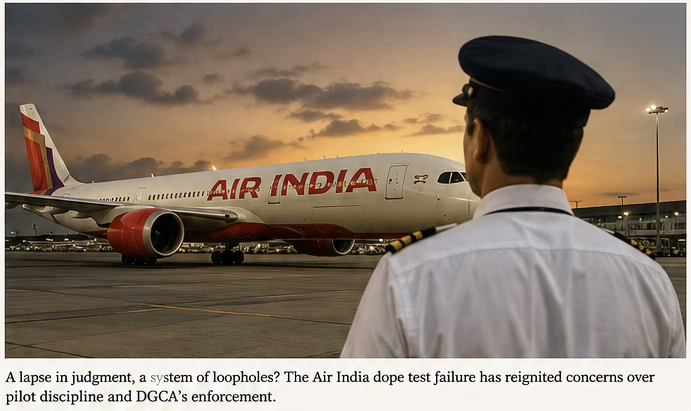
An Air India captain operating the Phuket–Delhi service that experienced a sudden loss of altitude has reportedly tested positive for marijuana in a confirmatory drug test. The Airbus A320neo lost about 300 feet of altitude during the August 4 flight, with 17 passengers and crew members reportedly injured. The captain had initially undergone a post-flight screening that was described as “not negative”, prompting confirmatory testing. The pilot was grounded while the matter was investigated.
The coincidence of a serious in-flight event and a subsequent positive test makes the case particularly disturbing. It does not, however, by itself establish that drug use caused the altitude loss. That question belongs to the ongoing investigation by the Aircraft Accident Investigation Bureau and other authorities.
But the episode does expose a larger vulnerability in aviation: rules are meaningful only when pilots, airlines and regulators enforce them consistently.
Why would a pilot take such a risk?
Commercial pilots operate in an environment where impairment can have catastrophic consequences. A pilot is expected to report fit for duty, comply with medical requirements and stay away from substances that can impair judgment, reaction time, coordination or situational awareness.
So why would a trained professional risk his licence and career? There is no single answer.
Fatigue, irregular schedules, long periods away from home, stress and personal problems can affect aviation professionals just as they affect people in other high-pressure occupations. Substance use can sometimes become a coping mechanism. Easy availability of recreational drugs in some locations and changing social attitudes toward cannabis can also create a false sense that occasional use is harmless.
There is another important factor: professional culture.
If employees believe that testing is predictable, enforcement is inconsistent or punishment can be negotiated, deterrence weakens. A rule can be perfectly written and still fail if the people subject to it believe the consequences are uncertain.

That is why the responsibility cannot end with the individual pilot.
The pilot’s responsibility is absolute
A pilot cannot outsource personal fitness for duty to an airline medical department or to the regulator.
The basic principle is straightforward: a person entrusted with an aircraft carrying hundreds of lives must not operate it when impaired or when prohibited substances have been consumed in circumstances covered by the applicable rules.
DGCA‘s framework governing crew alcohol testing already makes clear that operators have to conduct prescribed testing, maintain equipment and records, and report positive or missed cases. The applicable Civil Aviation Requirements also prohibit crew members from using substances that can impair their capacity to perform aviation duties.
The professional obligation therefore goes beyond simply “passing a test”. The pilot has to comply with the rule book even when nobody is watching. The airline cannot simply say: “It was the pilot”
Airlines have a second layer of responsibility.
An operator is not merely a company that employs pilots. It is a safety-management organisation entrusted with ensuring that people operating its aircraft meet regulatory and company requirements.
That means proper recruitment screening, medical oversight, drug-and-alcohol policies, training, awareness programmes, random testing where mandated, reliable reporting mechanisms and immediate removal from safety-sensitive duties when there is a credible concern.
The airline must also create an environment in which a pilot can report a problem without believing that asking for help will automatically destroy his career.
There is a delicate balance here. Support should never become leniency.
Counselling and rehabilitation may be appropriate in some circumstances, but they cannot substitute for regulatory action where the rule book prescribes suspension, licence action or other consequences.

Then comes DGCA
The Directorate General of Civil Aviation occupies the most sensitive position in this chain. DGCA describes itself as India’s civil aviation safety regulator. Its responsibilities include establishing and enforcing safety standards, licensing and oversight and monitoring compliance by operators and aviation personnel.
Its job is therefore not simply to investigate violations after they occur. It must create a regulatory environment in which violations are detected, reported and punished consistently.
That consistency is crucial.
If two pilots commit substantially similar violations but receive dramatically different treatment, the problem becomes larger than the individual cases. It becomes a question of regulatory credibility.
In a June 2022 a report titled “DGCA twisting rules to favour a private charter’s pilot”, Kalchakra News reported that Capt. H S Virdi, a private-charter pilot, had committed multiple violations involving mandatory Breath Analyser testing. The report mentioned that six earlier occasions in 2016 had been recorded in which Capt. Virdi allegedly flew without undergoing the required BA test. It further reported that when another violation occurred in February 2022, he was initially suspended for only one month, with the suspension later increased to three months after complaints were raised.
Nevertheless, the case raises a legitimate regulatory question: if similar violations are subject to clearly prescribed penalties, how are repeat offences counted and why should the treatment of one pilot differ from another? That question deserves an answer based on records, not speculation.
The public interest therefore lies not in demanding punishment for its own sake, but in demanding equal application of the rules.
According to a veteran pilot, Capt. PP Singh, “DGCA follows the ICAO requirements and hence is well compliant in this respect. Air India has an internal policy of termination in the first instance, which is more stringent than the regulations. As is the case with other laws in India, the rules are adequate or even excessive but implementation is weak.“
India is not alone. In the United States, regulators have long maintained extensive drug-and-alcohol testing requirements for aviation personnel. The National Transportation Safety Board has repeatedly highlighted impairment as an aviation-safety concern, including cases involving alcohol and illicit drugs.
In 2019, two United Airlines pilots were arrested in Glasgow after being suspected of reporting for a flight while over the alcohol limit; the flight to Newark was cancelled.
In Britain, an American pilot, Lawrence Russell, was jailed in 2024 after being found over the permitted alcohol limit before a scheduled Edinburgh–New York flight. A subsequent blood test recorded alcohol above the applicable Scottish legal limit.
In Australia, a Cathay Pacific flight from Sydney to Hong Kong was delayed for more than a day in 2024 after a pilot allegedly failed a pre-flight alcohol test. The airline suspended the pilot pending investigation.
In 2026, Malaysia Aviation Group announced mandatory drug testing and stronger screening after a Malaysia Airlines pilot was detained in Indonesia in a major drug-smuggling case; news reports confirmed that urine tests indicated cocaine and methamphetamine use.
The lesson from these cases is consistent: aviation authorities worldwide regard impairment and drug-and-alcohol violations as safety issues, not merely employment disputes.
What should happen now?
The Air India case should be investigated without prejudice and without a rush to judgment. But the investigation should answer several uncomfortable questions.
Was the pilot impaired during the flight? What exactly did the toxicology test establish? Were all required ‘pre and post’ flight procedures followed? Was the airline’s internal reporting system triggered correctly? Were there earlier warning signs? Were other crew members aware of any problem? And, critically, are DGCA’s enforcement decisions demonstrably consistent across airlines and pilots?
There should also be transparency about the regulatory process, subject to legitimate medical and privacy protections.
The objective should not be to create a culture of fear. Aviation needs a culture in which pilots can seek help before a problem becomes a safety incident.
But that culture can exist only alongside a firm principle: a safety rule cannot depend on who the pilot is, which airline employs him, or how influential his passengers may be.

Aviation operates on precision. Aircraft systems have checklists. Flight crews have procedures. Maintenance has documentation. Regulators have rules. The same precision must apply to enforcement.
If the Air India case ultimately establishes a serious violation, the response should be proportionate to the evidence and consistent with the rule book. If the evidence does not establish a violation beyond the required standard, that too must be respected.
The real test for Air India, the pilot and DGCA is therefore the same:
Will the rule book be applied equally when it is inconvenient to do so?
At 35,000 feet, passengers cannot choose which rules their pilot follows. They trust the airline and the regulator to make that choice for them.
That trust is the real safety system—and it cannot afford double standards.
*Images used in the article are AI generated